Nepal's Deadly Flood: China's Ruthless Role in the Catastrophe
When a catastrophic flash flood struck the Nepal-Tibet border region in August 2026, China was quick to blame nature. But behind the tragedy lies a familiar pattern: Communist infrastructure, censorship, and the silencing of those who dare to speak the truth.
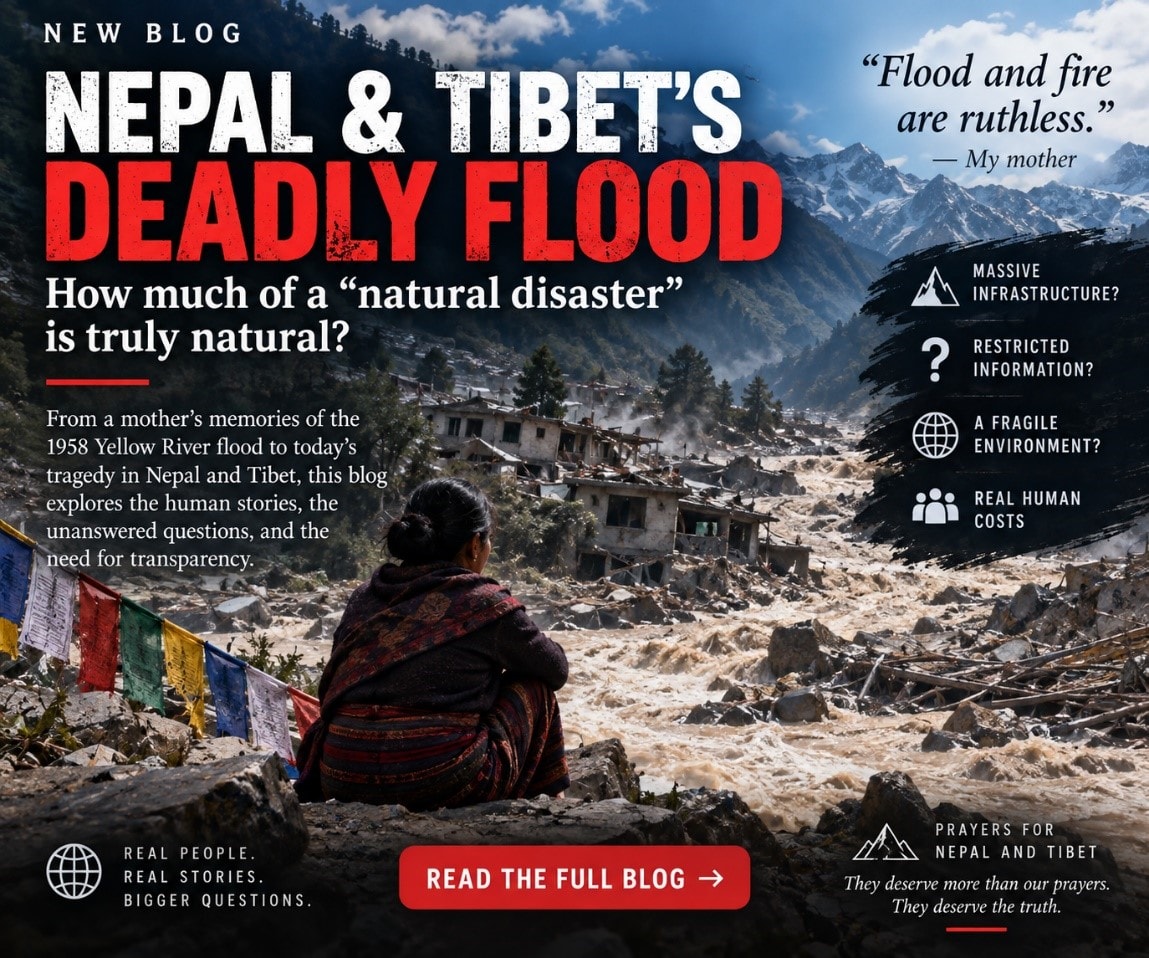
My mother passed away last year. Throughout her life, she witnessed and experienced many of the lies of the Chinese Communist regime. She often used to say, "Floods and fires are ruthless."
She knew something about floods.
In 1958, my mother was only 20 years old when the Yellow River flood struck. The flood inundated nearly 2,000 villages, affected more than 700,000 people, destroyed or damaged some 300,000 homes, and shut down the vital Beijing–Guangzhou railway for two weeks.
For my mother and countless others who lived through it, the flood was a terrifying natural disaster. During my childhood, my mother often sent me to stay with my grandmother during winter and summer school vacations because she was required to work long hours under the Communist labor system.
I remember seeing mothers with children, dressed in dirty, torn clothes, begging for food. My grandmother told me that many had lost their homes in the flood and were forced to wander from place to place just to survive.
Yet my elementary school textbooks told a very different story—one filled with propaganda about Mao leading the people to tame the Yellow River and save the country.
Looking back today, I understand that nature was not the only force behind the tragedy.
Just one year earlier, in 1957, Mao's government had begun building the Sanmenxia (Three Gate Gorge) Dam on the main stem of the Yellow River, promising that the massive project would tame the river and permanently control its floods.
Not everyone believed that promise.
Huang Wanli, one of China's most prominent hydraulic engineers, earned a master's degree in hydrology from Cornell University in 1935 and a Doctor of Engineering degree from the University of Illinois in 1937. He warned the Communist regime against damming the main channel of the Yellow River. Huang understood something that political ambition could not change: the Yellow River carries an extraordinary amount of sediment, and interfering with its natural flow could have devastating consequences.
For speaking out, Huang was severely persecuted under Mao's Communist regime. He was publicly denounced, stripped of his professorship, barred from research, and branded a "rightist." During the Cultural Revolution, Red Guards beat him with belts until his back bled and forcibly shaved part of his head to humiliate him. Huang calmly shaved the rest himself—and then shaved the heads of other persecuted professors. It was a quiet act of defiance and dignity in a Communist system determined to strip its victims of both.
Huang spent years enduring political persecution and forced labor. He paid a devastating personal price for defending scientific truth against Communist political ideology. His story is also a reminder of a larger danger: when a political regime demands obedience to ideology over evidence, silencing scientists can have consequences far beyond the lives of those it persecutes.
The Nepal Flood — I Could See the Writing on the Wall; Why Couldn't They?
On August 26, 2026, a catastrophic flash flood struck the Nepal-Tibet border region. Within minutes, raging water, mud, and debris swallowed entire villages and towns. Reports from Nepal said that at least 800 people had died and more than 3,000 remained missing.
Yet the Chinese Communist regime was quick to distance itself from the catastrophe, emphasizing that the glacier collapse occurred inside Nepal. In other words: this was Nepal's disaster, not China's.
What a shame. When thousands of human lives are lost or remain in danger, should borders be the first concern? To me, the response revealed something painfully familiar about the Communist system under which I grew up: protecting the regime's narrative comes before acknowledging human suffering and responsibility.
I kept thinking about something my mother used to tell me: "Floods and fires are ruthless."
She was right. As the initial shock and grief gave way to questions about how such a catastrophe could have happened, I began asking myself another question: Was nature the only ruthless force at work?
Reports increasingly drew attention to the geological risks surrounding massive infrastructure development in the fragile Himalayan environment. And the more I read, the more I could see the writing on the wall.
The Yale School of the Environment had previously reported concerns about China's construction of what is intended to become the world's largest hydropower project along the Yarlung Tsangpo River, in a seismically active region of the Himalayas. Chinese scientists themselves had warned engineers to take precautions against earthquake risks. Those concerns were hardly theoretical: in early 2025, a magnitude 7.1 earthquake near the Nepal border killed more than 120 people and destroyed more than 3,600 buildings.
Against this backdrop, questions naturally emerged about what had triggered such a sudden and devastating flood—and whether human activity or infrastructure in this fragile region could have played any role.
Chinese officials, however, offered a different explanation. They said that the catastrophic flash floods were triggered by the collapse of a glacier in Nepal. They also pointed to global warming as a factor contributing to glacier instability and, ultimately, the collapse.
The bottom line, however, was familiar: the Chinese Communist regime found causes everywhere—except in its own actions.
Let's Talk About Global Warming: How China Is Destroying the Himalayan Environment
When the Chinese communist regime blames global warming, the irony is hard to ignore. China is the world's largest annual emitter of greenhouse gases, responsible for roughly one-third of global emissions. It is therefore the single largest national contributor to the greenhouse gases accumulating in the atmosphere and driving global warming.
In Southeast Asia, when water levels in the Mekong River fall dangerously low, threatening fishing communities and the livelihoods of millions of people across the region, global warming is not the only factor. China has built a massive network of dams upstream on the Mekong—known in China as the Lancang—that can significantly alter the timing and flow of water downstream, adding pressure to communities already struggling with drought and water scarcity.
The same pattern is unfolding in Tibet. Since its invasion and occupation of Tibet, the Chinese communist regime has dramatically transformed the Himalayan environment while presenting massive dams, mining operations, infrastructure projects, and resource extraction as "economic development" for Tibetans.
But development that damages rivers, mountains, ecosystems, and the livelihoods of the people who have depended on them for generations comes at an enormous cost. Tibet is not simply a resource reserve for Beijing to exploit. The Tibetan Plateau is the source of many of Asia's great rivers, and what happens in Tibet does not stay in Tibet. The environmental consequences flow downstream across borders, affecting hundreds of millions of people throughout Asia.
Tibetan Lives Matter: Free Tibet from Communist Rule
For Tibetans, the Himalayas are more than mountains. They are sacred—a land deeply connected to Tibetan religion, culture, and identity.
In 1950, however, the Chinese Communist Party, led by Mao Zedong, invaded Tibet and claimed the region as part of China. The invasion and subsequent occupation marked the beginning of a profound assault on the Tibetan people—their land, culture, religion, heritage, and national identity.
In 1959, a major Tibetan uprising erupted in Lhasa. Chinese forces responded with a brutal crackdown. According to the Tibetan government-in-exile, citing captured Chinese military records, an estimated 87,000 Tibetans were killed in Central Tibet during the suppression of the uprising and its immediate aftermath.
Under the banner of "development," the Chinese Communist Party has built an enormous network of dams, highways, railways, tunnels, border settlements, and digital infrastructure across the Tibetan Plateau. CSIS warns that many of these projects serve strategic purposes as well—strengthening Beijing's military mobility, expanding its surveillance capabilities, and increasing its control over rivers that flow from Tibet into neighboring countries.
The regime's control over Tibet, however, extends far beyond physical infrastructure. It also controls information. When disaster strikes, the consequences of that censorship can be devastating.
Even today, we do not know how many people in Tibet died or remain missing after the flood because Chinese authorities tightly control information coming out of the region. Families are left searching for answers, while the outside world is left wondering about the true scale of the tragedy.
For decades, "rumor" has been a convenient label used by the Communist regime to discredit information that ordinary people witness but authorities do not want publicly discussed. Now, Chinese authorities are punishing people for flood-related posts they characterize as "rumors." When people can be punished simply for challenging the official narrative during a human tragedy, censorship does more than suppress information — it can leave victims invisible and families without answers.
On August 31, authorities announced administrative penalties against 10 people, including seven who reportedly claimed that the actual death toll exceeded 1,000. By September 3, seven more people had reportedly been summoned, penalized, or reprimanded for flood-related posts. According to the International Campaign for Tibet, at least 19 people have been targeted or punished for sharing disaster-related information.
Not surprisingly, firsthand information has become extraordinarily difficult to obtain. Residents are afraid to speak. One source told the International Campaign for Tibet that it was "extremely unsafe" to share information. Another reportedly asked the organization not to make further contact because of the danger.
The message is clear: Speak about what you have seen, question the official numbers, and you will become a target.
As usual, WeChat groups and online comment sections operate under the Chinese government's tight censorship system. Critical comments are removed, and firsthand videos have disappeared from Chinese social media. Meanwhile, state media emphasize government directives, rescue operations, and road repairs while providing limited information about casualties, missing people, and survivors.
This is what Communist censorship looks like in the midst of a human tragedy. At precisely the moment when reliable information can help locate the missing, identify communities in need, and save lives, information is suppressed—and people are frightened into silence.
I know this fear because I lived under this Communist system. When the authorities decide what is "truth" and what is a "rumor," even telling others what you witnessed with your own eyes can put you in danger.
How much of a "natural disaster" is truly natural when the Chinese communist regime controls everything? When the same regime controls the land, the rivers, the infrastructure, scientific information, the media, and even what grieving families are allowed to say, the world has every reason to demand transparency and answers.
Tibetan lives matter. I stand with the Tibetan people in their struggle for freedom from Chinese Communist rule. Their voices should not be silenced. Their suffering should not be hidden. And their lives should never be reduced to numbers that the regime decides the rest of the world is allowed to see.
Prayers for Nepal and Tibet in the Wake of Devastating Floods
In Nepal's hard-hit Nuwakot district, survivor Kalpana Malla described watching her entire family being swept away before her eyes. Her mother, father, sister, and young nieces and nephews were all taken by the flood. The water came so quickly that there was no time to run. "They could not escape the flood; there was no chance at all," she said.
Downstream, in the scenic Chitwan district, the tragedy took another heartbreaking form. Local authorities began mass burials. Hundreds of bodies had been carried so far by the raging water that they could no longer be identified. Families searched relief camps for missing loved ones, not knowing whether they were still alive—or whether someone they loved was among the unidentified dead.
Thousands of miles away, Rajan Tamang, a restaurant owner in New York City, learned that his mother and sister had died. Many other relatives and friends were still missing. His family had been waking up that morning when the flood suddenly struck. There had been no warning. There had been no time to escape.
These are the human faces behind the numbers.
Behind every death is a life that mattered. Behind every missing person is a family waiting for an answer. Behind every destroyed home is a community that must somehow start anew.
This is why truth matters so much in the aftermath of a disaster. Families deserve to know what happened to their loved ones. Communities deserve to know what caused the catastrophe and whether it could have been prevented or its consequences reduced. The world deserves honest information—not censorship, propaganda, or silence.
For the people of Nepal, we can see at least some of the faces, hear some of the names, and listen to survivors tell their stories. For the people of Tibet, even the full scale of their suffering remains obscured behind the Chinese Communist regime's wall of censorship.
That silence should trouble all of us.
My heart and prayers are with the people of Nepal and Tibet—with those who lost mothers and fathers, sons and daughters, brothers and sisters; with those still searching for the missing; and with those who have lost their homes and communities.
May the dead rest in peace. May the missing be found. May the survivors find strength to rebuild their lives.
May the people of Nepal and Tibet receive something every victim of tragedy deserves: compassion, truth, and answers.
Explore Topics
Written by