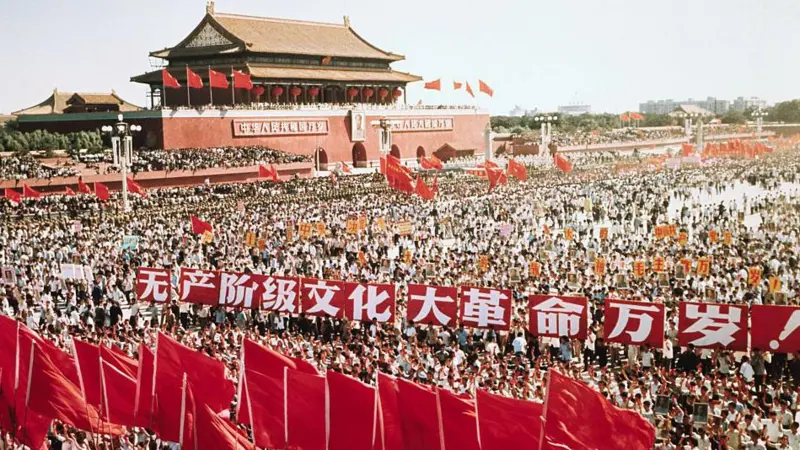
(Photo from BBC: 60th Anniversary of the Cultural Revolution: Understanding This Decade of Cultural Catastrophe Through Key Keywords)
July 1 is the official founding date of the Chinee Communist Party (CCP). For me, it is not a day of celebration. The CCP’s rise to power led to decades of political repression, persecution, and human suffering, the effects of which continue to shape China today. Rather than celebrating the legacy of communism, I believe it should be remembered as a cautionary lesson and condemned for the harm it has inflicted on the Chinese people.
In 1936, Edgar Snow, an American journalist from Missouri, was invited by the Chinese Communist leader Mao Zedong to visit the Communist base in Shaanxi. Snow conducted a series of interviews with Mao that year and published Red Star Over China, in 1937. The book became a major propaganda victory for the CCP, allowing them to present their story largely on their own terms.
Red Star Over China helped create a romanticized Western view of Mao and communism. The book was written and published shortly after the Long March—the CCP’s military retreat that began with about 100,000 troops in 1934 and ended with only about 8,000 survivors in 1935. To romanticize the CCP dictator, Snow ignored the fact that approximately 92% of participants in the Long March did not survive. Rather than liberating China’s poor, Mao led a movement that exacted a tremendous human cost on its own followers.
By portraying Mao and the Communist movement in a favorable light, the book helped shape a misleading international perception of the CCP for decades. It was quickly translated into more than 20 languages and read around the world, turning Mao Zedong into a household name. Before its publication, few people outside China knew much about the Chinese Communist movement.
Today, I often hear Western media praise the Chinese Communist Party, claiming that it lifted 1.5 billion people out of poverty. The claim that the Party deserves all the credit is, to me, mind-boggling. In the first place, who made Chinese live in extreme poverty? As a Chinese national, I believe this praise is misleading and, in some respects, amounts to misinformation.
Who Made Chinese Extremely Poor? – Communism
After taking power in 1949, CCP leader Mao Zedong closed off China to much of the outside world, and the Chinese people lived under a rigid communist system. During the Great Famine from 1959 to 1961, millions of Chinese died of starvation. Mao’s government attributed the disaster to natural causes and rejected outside humanitarian assistance from Western countries.
The famine left an enduring scar on a generation of Chinese families. Throughout my childhood, whenever I left food in my bowl, my mother would remind me of those terrible years. She often told us how hungry she was during that period, how she sometimes lay awake at night because of hunger, and how she witnessed people collapse and die from starvation on their way to work.
Between 1966 and 1976, Mao Zedong spent ten years mobilizing young people to wage the Cultural Revolution, a campaign against capitalism, traditional Chinese values, and basic humanity. Higher education was shut down, and professors, intellectuals, and other educated people were sent to re-education camps for political brainwashing.
I was born during this dark decade. In elementary school, our textbooks were filled with revolutionary propaganda and praise for the Communist Party. “Without the Communist Party, there would be no New China” and “Mao is our Savior” were the kinds of slogans we were taught. Teachers were not allowed to teach much beyond these political messages.
Fairy tales, folk stories, and children’s books were banned and condemned as products of feudalism and capitalism. Instead, the government produced a series of illustrated books, similar to American comic books, that portrayed landlords, factory owners, and merchants before Communist rule as cruel and evil. Many of these stories were fabricated or heavily distorted. Their purpose was to indoctrinate children and stir up hatred toward anyone associated with China’s pre-Communist society.
During my elementary school years, the Communist Party promoted a role model named Zhang Tiesheng. Zhang was his family name, and Tiesheng, meaning “iron birth,” was his given name. The name symbolized Communist ideals, as iron forged in fire was often used by the CCP as a symbol of revolutionary strength and loyalty.
Zhang was portrayed as a poor working-class youth who constantly challenged his teachers and failed in school. Although he was illiterate, he claimed to love the Communist Party above all else. He became “famous” after submitting a nearly blank answer sheet on a national school examination. It was a bizarre story, yet the government celebrated him as a hero and promoted him as a role model for revolutionary students. In the eyes of the Communist Party, political loyalty mattered more than education, knowledge, or academic achievement.
Ignorance and centralized control led to economic disaster in China. Shortly after Mao took power on October 1, 1949, he launched the Great Leap Forward, a campaign intended to help China catch up with and surpass the United States, Britain, and other Western countries in agriculture and industry. The result was catastrophic. Local officials, fearful of punishment, exaggerated production figures and reported false successes to higher authorities. The campaign ultimately contributed to a devastating famine that lasted from 1959 to 1961.
During the ten years of the Cultural Revolution, the government focused more on political campaigns than economic development. Because the Communist Party controlled every aspect of society, it decided what farmers should grow and what factories should produce. Economic decisions were made according to political plans rather than market demand or practical needs. The result was widespread poverty and chronic shortages.
For the first twenty years of my life, food choices were extremely limited. In winter, we ate little besides Chinese cabbage. In summer, people stood in long lines for cucumbers, crushed tomatoes, or whatever vegetables happened to be available that day. Sugar, salt, cooking oil, soy sauce, meat, fish, and eggs were all rationed according to the number of people in a household. And this was life in the cities. In rural areas, conditions were often even harsher, with many people surviving on whatever food they could find.
What Made Some Chinese People out of Poverty? – Capitalism
Traditional Chinese culture has long emphasized the value of education, hard work, and personal responsibility as the path to prosperity. When I was a child, my grandmother often told me stories about life before Communist rule. She said that landlords owned private property and hired farmers to work their land, and that most landlords treated their workers fairly. According to her, those who worked hard could improve their lives, while those who were lazy or addicted to drinking and gambling often became poorer over time.
The purpose of Communist rule was to eliminate private ownership, seize private wealth, and place all valuable assets under the control of the state. The result was that ordinary people became poor while Communist leaders and corrupt officials enjoyed privileges denied to everyone else.
I grew up in a courtyard that once belonged to a wealthy family. After the Communist takeover, the property was confiscated and divided among many families — sometimes 10, 20, or even 50 families, depending on how many rooms the original owner had. Most families cooked outdoors because the rooms assigned by the government were barely large enough to serve as bedrooms and living spaces. All the families in the courtyard had to share a single water tap and public bathrooms.
The contrast between ordinary citizens and the Communist elite was impossible to miss. One of my classmates lived in a crowded courtyard near the Forbidden City, where dozens of families shared limited living space and basic facilities. She often told us that her family’s outdoor cooking area was located next to a high wall separating their courtyard from the compound where the parents of Xi Jinping — the current Chinese President — lived after returning to Beijing following Mao’s death in 1976. Because of the proximity, she sometimes overheard conversations between Xi and his nanny or family cook.
The contrast between the two compounds was striking. On one side, ordinary families lived in overcrowded conditions, sharing water taps, cooking areas, and public bathrooms. On the other side of the wall stood a secluded residence occupied by a single family and guarded by soldiers. While ordinary citizens struggled with cramped living conditions and shared basic facilities, the families of senior Communist officials enjoyed spacious homes, privacy, and special protection.
Communism never meant equality in practice. It was about controlling people’s property, opportunities, and daily lives. Despite this system, Chinese people continued to hold on to values passed down through generations—valuing education, working hard, and striving to build a better future for themselves and their families.
I was fortunate that Mao died while I was still in elementary school. After his death, China began a period of reform and opening. Universities reopened, and higher education was restored. For the first time in many years, high school graduates once again had the opportunity to compete for college admission. For students and their families, attending college was a dream because it offered the possibility of a better life and a better career.
I was lucky to have that opportunity. Through hard work and study, I was able to earn admission to one of the best universities in China. My success was not the result of Communist ideology, but of the traditional Chinese belief that education and hard work can change a person’s future.
In the 1980s, Deng Xiaoping, China’s top Communist leader, introduced economic reforms that allowed limited elements of capitalism and private enterprise. For the first time in decades, some Chinese were permitted to start their own businesses. Deng famously said, “Let some people get rich first.”
The small fraction of the population that was able to take advantage of these reforms helped transform China’s economy. Ordinary people began to see signs of prosperity that had been largely absent under Mao’s rule—fashionable clothing, private businesses, restaurants, and personal automobiles. For many Chinese, these changes demonstrated the benefits of greater economic freedom and created hope for a better future.
By 1989, many Chinese believed that economic reform would eventually lead to political reform and a more democratic society. That hope was crushed on June 4, 1989, when Deng Xiaoping and other Communist Party leaders ordered tanks and troops into Tiananmen Square and the streets of Beijing to suppress the pro-democracy movement. Thousands of protesters were killed or injured, bringing a brutal end to the optimism and aspirations that had inspired so many Chinese to seek political change.
History shows that it was not the Communist Party that lifted Chinese people out of poverty. It was hardworking Chinese men and women who struggled, sacrificed, and worked tirelessly to improve their lives. Their opportunities expanded only after the regime began allowing limited elements of capitalism and private enterprise into the economy. The economic progress that followed was driven by the efforts, talent, and determination of the Chinese people themselves.
Why Are Some Western Media Outlets Willing to Echo the CCP’s Propaganda?
After Mao’s death, China began to slowly open to the outside world in the 1980s. Because the country had been isolated for so long, the arrival of foreigners often attracted great curiosity. When foreigners appeared in public, crowds of Chinese would sometimes gather around them, staring at them as if they were exhibits in a zoo. It was a strange and memorable way of welcoming foreign visitors.
The Chinese government was embarrassed by the poverty and poor living conditions that many Chinese people faced, so it tightly controlled where foreign visitors could travel and stay. When foreigners visit China as tourists, business travelers, or temporary workers, they are often given a carefully managed view of the country. Chinese authorities want them to see China’s most developed and prosperous areas, particularly its major cities. As a result, many foreigners have little opportunity to observe how ordinary people live in rural and remote regions.
The reality is that most foreign visitors rarely encounter the living conditions of people in these areas. About 840 million people — or about one-ninth of the world’s population — live in China’s rural areas. Many have not escaped poverty, and life remains extremely difficult under the dictatorship of the Chinese regime. In many areas, people still lack running water, electricity, decent sanitation facilities, and adequate housing.
As a result, many foreigners form their impressions of China based on a limited view of the country. What they see in major cities and developed regions does not fully reflect the experiences and hardships faced by hundreds of millions of Chinese citizens.
It should be noted that the United States and most of the world are pleased to see China develop and the living standards of the Chinese people improve. As the World Bank noted, “Since 1978, the beginning of China’s reform and opening-up period, GDP growth has averaged over 9 percent a year” (World Bank, 2025).
China’s economic rise, however, was not the result of communism; It was driven by the introduction of limited capitalism, the hard work and entrepreneurship of the Chinese people, widespread appropriation of foreign technology and theft of intellectual property, and aggressive efforts to secure markets and natural resources across Africa, Latin America, and the Middle East.
Yet many Western media outlets, whether intentionally or not, help promote the Chinese regime’s narrative that the United States is in decline and can no longer compete with China. This claim ignores both history and reality. China’s prosperity emerged only after the regime relaxed some of the very communist policies that had kept the country poor for decades. The claim that communism made China prosperous is one of the most deceptive stories of our time.
From Communism to Freedom: Why I Believe in America
By the age of 40, while living in China, I felt trapped. My dreams were fading, and I saw no future for myself under communism. I never imagined that I would have the opportunity to start over in a new country. Yet, against all odds, the United States welcomed me.
At 41, I arrived in the United States to pursue my American dream by attending graduate school. I had only enough money to cover the tuition required by law for my two-year master’s degree program. After my first year, immigration regulations allowed me to work up to 20 hours per week on campus, which helped me pay for rent, food, and other necessities. I was deeply grateful for that opportunity.
After earning my degree, U.S. law allowed me to stay and work for one year in a position related to my field of study. Determined to build an independent life, I often worked four part-time jobs at the same time. For the first time in America, I could support myself and pay my own rent and grocery bills.
My days were long but rewarding. I caught a bus at 5:00 a.m. to teach in a Chinese language enrichment program at an elementary school. From 9:00 a.m. to 2:00 p.m., I worked as a library assistant on campus. From 3:00 p.m. to 6:00 p.m., I taught in an after-school program at another elementary school. On weekends, I worked at a museum, assisting with family education programs and helping parents and children make the most of their visits.
My schedule was packed, but I was happy. Every job represented an opportunity to learn, gain experience, and move closer to a better future. For someone who had grown up under communism, the ability to shape my own destiny through hard work was a freedom I deeply appreciated.
Thanks to America, I found many opportunities. I was able to pursue higher education, build a career, and achieve far more than I ever thought possible.
In the United States, I experienced poverty and often worried about whether I would have enough money to pay my rent. Yet I worked hard and never relied on government assistance programs. I faced limitations because of my immigration status, but I pursued every job opportunity available in my field, regardless of how low the hourly wage was.
I also encountered discrimination because of my race and limited English proficiency. Rather than letting those obstacles discourage me, I listened carefully to native English speakers, worked to improve my pronunciation and vocabulary, and made every effort to speak English whenever I had the opportunity.
The challenges were real, but so were the opportunities. Through hard work, perseverance, and a willingness to learn, I was able to build a new life in a country that rewards effort, initiative, and determination.
I am only one among millions of immigrants who came to the United States to pursue and live the American dream. My story is not unique. It reflects the experience of countless people from around the world who have come to America in search of freedom, opportunity, and a better future.
The narrative that the CCP regime is more advanced than the United States ignores a fundamental difference between the two countries. The United States is a land of freedom and opportunity. It is a country where people are free to speak their minds, pursue their dreams, start businesses, practice their faith, and shape their own futures. Those freedoms continue to make America a unique and powerful force in the world.
America at 250: A Celebration of Freedom, Opportunity, and Hope
As the United States celebrates its 250th anniversary, I join in honoring this remarkable nation and its extraordinary achievements. America remains the world’s leader in innovation, higher education, entrepreneurship, military strength, and scientific research. More importantly, it continues to offer something that millions of people around the world still seek: the freedom to dream, the opportunity to succeed, and the hope of building a better life through hard work, perseverance, and determination.
Did the Chinese Communist Party Really Lift 1.5 Billion People Out of Poverty?
Ignorance and naïveté would answer YES. The truth, however, is a big NO.